Monday, 7 April 2025

Trump is right - the international economic model is broken


As we watch Trump blow up the international economic model, we should at least agree with him that the model needs to change. For too long, we have relied on the US as ‘consumer of last resort’, a model that was created in the 1970s and entrenched by Thatcherism and Reaganomics. Sure, the model imploded in 2007-8, and bank bailouts and the ensuing austerity made things worse, but it had already been broken by the export-led Asian miracle economies of the 1980s:


The Post-Keynesian accounting approach ‘shared by Godley, Baker, Hudson, Keen and others was predictively successful for the 2007-8 crisis, and also the theoretically most developed’ (Bezemer 2010).  But since 2008, China has diversified both its export markets and its investments, mimicking the long-running 'exorbitant privilege' of capital exports by the US, and we need to look beyond stock-flow consistent models.

To fully grasp this Trump moment, I suggest we look back to the interwar period. Then, Keynes proposed a system of multilateral clearing for trade imbalances. Creditor and debtors would be charged for racking up large surpluses and deficits, but with smaller tariffs (5-10%) on creditors. Adjustment would come by allowing debtors to competitively devalue and re-build their industrial base, accompanied by a ban on capital exports. In part, China's economic miracle was built by limiting US capital exports - but without the headwinds of US tariffs and a devaluation of the US Dollar.

There is a deal to be done, therefore, and one that will save the world from a different threat - climate inaction. We should accept Trump's assertion that the US Dollar needs to devalue, and that tariffs may be necessary to encourage surplus countries to make reciprocal investments in the US. But that should be conditional on the US accepting restrictions on their capital exports - US firms should not be investing in Taiwan, or in new oil projects outside of its borders. We could go further, and seize this opportunity to ban all new investments in fossil fuel extraction. It may not be possible to stop Trump investing in shale gas domestically, but a ban will mean that countries investing more rapidly in the energy transition will benefit first. 

There are other lesson from Keynes, too. Trump's tariff rates are way too high, and the lesson from Europe in the 1930s is that retaliatory tariffs make things worse - contributing to inflation and nationalism. Cooler heads are needed, as well as a cooler planet. Yes, the international economic model is broken; and yes, too, there is a deal to be done.

Friday, 13 March 2020

Laissez-faire economics won't save us from COVID-2050


A laissez-faire approach to coronavirus, no matter how much we get nudged - individual responsibility to wash our hands, avoid planes and public transport, and self-isolate - will not stop the spread of the virus. What the economy needs is not words, but a strong, fiscal response to supply the physical assets that we need to push this virus back. In those terms, the recent UK budget was not ambitious enough. 


I'm not talking about the supply of toilet rolls, sanitiser and pasta, I'm talking about spending on measures to restrict the spread of the virus. I don't know much about NHS Labs, but it appears they hit a supply side constraint because, despite scaling up and there being a 10-minute test available, the UK will "stop testing members of the public who display mild symptoms". The same is true of hospital beds, where UK hospitals rank amongst the lowest in Europe; on top of an NHS staff shortage and the closure of community hospitalsI know the evidence is mixed, but providing temperature checks at stations, ports, and airports could catch just over half of coronavirus-infected passengers


Specific supply side constraints are not solved by lowering general interest rates, but by strong and targetted fiscal policy. Yes, there has been some money for the NHS, but it has been constrained by ten years of austerity. From this weakened base, the cautious UK response could include more incentives for people to do the right thing and stay at home if they are sick, including the self-employed and low-waged. Given the low NHS base, the UK needs more stringent controls on the movement of people than our European and Asian neighbours, not less.


Where to start? As a climate activist, I would have no qualms about grounding flights for a few weeks.  Why not push harder on that net zero by 2050 door at the same time? After all, as my 13-yr old son joked last night, we don't yet know how bad the COVID-2050 strain will be. 


Indeed, our service industries depend upon the UK being a safe place to visit. Imagine if there was no yellow fever vaccine - with a fatality rate of about 5% - few people 'at risk' would travel to areas where yellow fever is endemic. Whether the case fatality rate for COVID-19 is similar or turns out to be less because of undiagnosed cases, there are around 1 billion 'at risk' over 60s today, forecast to double by 2050. Prepare for the worst, and hope for the best.


What does more stringent controls on movement mean? Ensure people can work from home for the same pay; cancel large gatherings and move to virtual events; use video calling in at risk settings, GP surgeries and care homes; offer online exams and tutorials at Universities; encourage less (and longer) overseas and other trips; help elderly neighbours get their groceries. These are familiar themes to climate activists - live locally and act globally.

Achieving net zero creates both supply and demand side problems, but the UK government should have few qualms about letting CO2-intensive companies fail under 'tooth and claw' capitalism if they are not going to meet those 2050 climate goals - this is not a time to spend £27bn on motorways and roads. Given the laisser-faire response of the UK and other governments it may be too late to hold back COVID-19. But it is not too late to plan for COVID-2050.

Thursday, 7 December 2017

Using Bloomberg From R and Excel


Bloomberg from R

First, you need to be logged on to Bloomberg.

If the Bloomberg/Excel add-in does not work, then:
1. Close Excel and/or R
2. Keep Bloomberg running
3. Go to Start-> Bloomberg -> API Environment Diagnostics
4. Click Start when the Bloomberg API Diagnostics window has loaded
5. If a “Login to wintrv…” message below then pops up, this occurs when Bloomberg isn’t open – it is highly recommended that you have Bloomberg running; you can proceed without it, but you may not be able to resolve some errors if you do so
6. Once the check is finished, you will get a 'Diagnostics completed' message
7. If the Repair button is available to press on the Bloomberg API Diagnostics window, it means it needs to run the repair and you should do so by clicking Repair (it should take a couple of minutes)
8. Once the check is done, and repair if necessary, the ideal state is all green ticks except for 2 yellow “!” for Dotnet Installation and Excel Throttle Interval only. Else, you can still run Excel or R-Studio and see if the Bloomberg-associated functionality is working.

# install the Bloomberg package, and connect
install.packages("Rblpapi")
library (Rblpapi)
blpConnect()

# get the Bloomberg data history for SPY US Equity - last 100 days - and plot it
x <-  bdh("SPY US Equity", "PX_LAST", start.date=Sys.Date()-100)
plot(x)

# find out what other fields are available for prices
res <- fieldSearch("price")
res

# get the Bloomberg data history for SPY US Equity - last 100 days - and plot it
x <-  bdh("SPY US Equity", "OPEN", start.date=Sys.Date()-100)
plot(x)

Bloomberg from Excel

As above, if the Bloomberg/Excel add-in does not work, then repair (Steps 1-8).
Open an Excel Sheet, and type the following into a cell:
Historical prices: BDH("F US Equity", "PX_LAST", “16/11/2000”, “15/11/2016”)
This will give you the last traded price (PX_LAST) for 'F US Equity (Ford Motor  Company) from 16/11/2000 to 15/11/2016. The first parameter must be the Bloomberg stock code.

For DMU students, this URL shows how to get data from Bloomberg into Excel.
Also for DMU students, this URL shows how to use Bloomberg.


Monday, 25 September 2017

Ukraine's path to prosperity


You can get an Uber in Ukraine. Investment is more difficult, because borrowing in local currency (Hryvnia) is expensive. The official interest rate is 12.5%, local currency mortgages cost around 20% and credit cards cost around 40%. To borrow more cheaply, many households took out USD mortgages prior to the Global Financial Crisis but, when the Hryvnia collapsed, these became unmanageable. Subsequently, the parliament (Rada) banned foreign currency mortgages and imposed a moratorium on the confiscation of property by the banks. The government finds it equally difficult to borrow cheaply, with the most recent sovereign Eurobond issue at 7.375%. The cheapest borrowing is reserved for privatised companies that export commodities: for example, LSE listed Ferrexpo, which is 51% owned by Rada member Kostyantyn Zhevago and exports iron ore pellets, has bond yields as low as 3.7%.  

Unsurprisingly, Ukranian public opinion is that the financial system is loaded against them. Two-thirds of sovereign bonds are issued in foreign currency, which means that Ukraine must have a constant stream of foreign currency to meet its payment schedules. When Ukraine does well, the Hryvina strengthens and foreign currency is easy to get. When Ukraine does badly, as it did after the conflict in the East, the Hryvina devalues and there is a scrabble for foreign exchange to satisfy creditors. Official statistics suggest that the central bank has enough foreign exchange reserves for about 3.5 months of exports, at $18 billion, but there is another $90 billion held privately by individuals. 


The conditionality attached to foreign loans is depressingly familiar, with the IMF requiring a maximum 3% public deficit, and the World Bank calling for sustainable public pensions. This, at a time when the minimum pension is little more than $2 per day.

And therein lies the trap. Public borrowing is heavily constrained, and private borrowing is too expensive. Notionally, the primary target of the central bank is inflation, and they have implemented tough measures to stabilise the foreign exchange rate. But lowering the interest rate requires reforms to reduce the cost of borrowing from local banks: better regulation, banking competition, less corruption, enforceable contracts, recognised accounting standards and clear accountability. Without deeper reforms, the risk is that the Rada will continue to make the same mistakes: hasty privatisations and sales of public land to ease the budget pressures but, in the process, creating the conditions for a new class of wealthy elites. Part of the problem is the Rada itself, which is unicameral (one legislative chamber) with code-based law. Here, the outlook for reform is less clear.

What’s to be done? At the Ukrfinforum last week (21/9/2017), Yanis Varoufakis called for a new Bretton Woods agreement. The World Bank and IMF could acknowledge that the financial system is heavily loaded against ordinary people, accept the need for International reforms, and back off on the conditionality around sequencing: they could support any measures that reduce the cost of borrowing, including an end to the war. The economy will turn round when Ukranians are confident and able to borrow and invest locally, which in turn will reduce Ukraine’s dependency on foreign exchange being earned by a small number of commodity exporters.

Wednesday, 25 January 2017

Infrastructure activism


The highlight of the inaugral NEKS conference was to hear Sir Vince Cable talking about Theresa May's industrial strategy, which he describe as a 'rebranding [of the 2011 strategy] with some good new features'. He reminded us that the UK abandoned interventionist policies in 1979, a state that remained until Mandelson's car scrappage scheme in April 2009, followed by support for the UK aerospace sector.

Sir Vince told us that he concocted a letter with Michael Heseltine, who had an adjacent office, asking David Cameron to be more strategic about UK government procurement. Two big ideas followed. The first was to encourage long-term, strategic thinking by government, leading to such things as the recently launched National Infrastructure Commission; the second was to directly support key sectors such as aerospace, cars, textiles, apprenticeships and University Innovation Centres. Sir Vince reminded us that we should also question economic wisdoms: in terms of revealed comparative advantage, the UK is supposed to put all its eggs in one basket and concentrate on financial services. BREXIT poses a new question for industrial strategy: do we 'take back control' and become more interventionist, or do we relinquish control to the markets?

In explaining how the UK handles infrastructure today, Bridget Roswell told us about the National Infrastructure Commission (NIC), an Executive Agency that reports to HM Treasury. The NIC is designed to circumvent short-term electoral cycles by developing long-term infrastructure plans for transport, energy, water, sewerage and telecoms. At the conference, I heard several different approaches to long-term planning, but the problems were the same: how do you measure success, which criteria do you use? Francesca Medda (UCL) described a portfolio structuring approach, designed to optimise a portfolio of projects combining negative NPV/high social value projects with positive NPV/lower social value projects. Others, such as Tim Foxon (SPRU), outlined ways to involve the local community in the appraisal and selection of suitable projects.

It is always difficult squaring the circle between objective and subjective approaches to project appraisal. I was reminded of the solution adopted for the schools' funding formula: central government sets the boundaries within which each local authority must work. On the one hand, there is an objective framework that is the equivalent of UCL's social value optimisation. On the other hand, local authorities tweak the formula to meet local needs. However, the option to consider non-financial measures barely features in the infrastructure regulation. Chris Green (SQW) and Nicholas Miles bemoaned that the majority of transport projects look only at 'time saved', which an optimiser would rapidly transform into something akin to Le Corbusier's Plan Voisin:


Several conference participants came up with alternative factors that local communities might want to consider: health, productivity, distributional effects, ecological value, direct consumption value, and so on. Goodhart's Law is clearly at play here: 'when a measure (journey time saved) becomes a target, it ceases to be a good measure'.

In several breakout sessions, we discussed how we might persuade private investors to look beyond short-term financial gain. Steve Keen berated economists for narrow-thinking, as did Sir Vince who plugged the 'brilliant book written by Manchester students'. But there was also room for optimism. Sir Vince highlighted the alternative business model of The People's Trust whose objective is to 'achieve sustainable, long-term growth' via an alternative investment fund 'owned 100% by our members'. This is not investment advice, but a £20 bet, to help them launch, seems worth it to ensure an alternative to non-interventionist pension funds.

To sum up: I took away two strategies if we are going to 'take back control'. First, put public funds to better use through localism, or social value index optimisation, or both. Second, reinvigorate private investor activism.

Wednesday, 27 April 2016

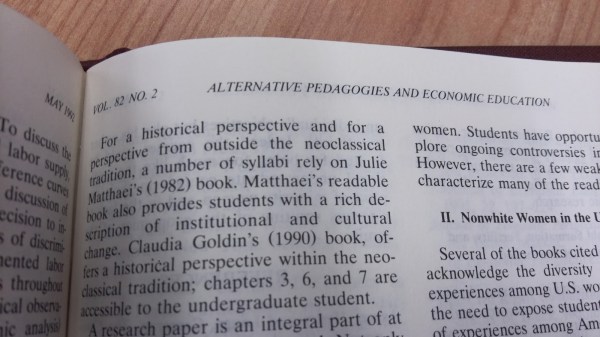
Pluralism since the ‘1992 Plea’ in the AER

First published on the Rethinking Economics Blog, March 12th 2014

In May 1992, a ‘Plea for a Pluralistic and Rigorous Economics’ was published in the American Economic Review (Vol 82 No. 2). It was signed by Harcourt, Galbraith, Goodwin, Kindelberger, Minsky, Pasinetti and other eminent economists. The Plea was funded by FEED who launched a second ‘Plea’ in 2009 and support the 2012 ‘Manifesto for Economic Sense’.  Geoffrey Hodgson, Research Professor in Business Studies at the University of Hertfordshire and one of the co-organisers of the ‘1992 Plea’, is interviewed here about the history of economic pluralism, and the challenges facing economics today.


NL: Twenty two years after the ‘1992 Plea’, do you think the mainstream has changed?
GH: I think things have changed in economics, to some degree. It’s not entirely positive, but in some senses economics is more diverse now that it was twenty two years ago… for example, new areas like experimental economics and behavioural economics have gained respectability. The main problem now with economics is not so much its diversity, or its insufficient internal pluralism, but the way that technique dominates and gets in the way of substance. Economists are engaged with mathematical puzzle solving rather than real-world problems…
NL: By that you mean things like regression analysis and theoretical model building?
GH: Theoretical model building and econometrics … that is all that now seems to matter in terms of publication in top journals or academic promotion. The whole discipline has become dominated by people who are very clever in technique but innocent of many important aspects of the real world and the history of their own discipline.
NL: In that 1992 Edition of the AER there were some pluralist surveys of economists, do you think the AER would publish that kind of qualitative research today?
GH: Generally it is very difficult to publish anything like that, and not just in the AER. I include other leading journals, like the Quarterly Journal of Economics or the Economic Journal in the UK… although occasionally they publish qualitative pieces, to spice up interest in their journal.
NL: What successes have you seen in the campaign for pluralism?
GH: The ‘1992 Plea’ was an early ringing of alarm bells about the nature of the discipline and the way it had been developing. It may have stimulated further similar complaints, such as from the French student movement… and dispersed attempts in Cambridge and also in the US… but the real change came with the 2008 crash. This provoked a much larger tide of complaint among students and others about the alleged inadequacies of mainstream economics.
NL: Was there a pluralist movement prior to the ‘1992 Plea’?
GH: Several prominent economists had made complaints. The petition was preceded by an important 1988 report by a commission of the American Economics Association, called ‘Report by the Commission on Graduate Education’ (Krueger et al, 1991), which complained about the dominance of technique in the discipline. A number of leading individuals, including Milton Friedman, also complained about the subject turning into advanced mathematics.  The most important event was the 1988 commission and its critical and scathing report.
NL: Did it have any success at the time?
GH: No.
NL: So why do you think the profession keeps coming back to these very inward-looking methods?
GH: The economics profession has an internal reward system that gets reinforced and replicated. Someone once compared it to the peacock’s tail. Once this positive feedback loop gets established, then people look for the glorious tail feathers despite their questionable usefulness. Fancy mathematics gets economists published and gets them promoted. As those people rise in the profession they will recruit people who perform similarly and the same kind of behaviour gets replicated. Other people, who think more widely or philosophically, or are more interested in the history of the subject or how it has changed, or who look more deeply at the conceptual assumptions, don’t get considered for influential positions in the discipline.
NL: What advice would you give Rethinking Economics?
GH: I hate to be pessimistic, because I don’t want to dampen the enthusiasm of those people committed to this, but unless you get some of the top universities appointing professors who are more broad-minded, who are not dominated by technique, who have influence, and some of the top journals consider more conceptual, historical material rather than simply technique-driven material,  then it will fail. Mark Blaug, who was a friend of mine who died a couple of years ago, got very pessimistic about this, and so did Ronald Coase who died last year. Another problem is that American economics is now overwhelmingly dominant. I often ask people… can you name a living British economist…  and they really have difficulty thinking of anybody. When mainstream economists took over the Cambridge department in the 1980s, after the era of Robinson and Kaldor, their explicit aim was to make Cambridge a rival to the top American Universities In other words, they aimed not to develop Cambridge’s own niche, but simply to follow what America was doing. You are inevitably 5 years behind if you are lucky, and that US emulation has led to the near-destruction of British economics… with this subservient mentality it is very difficult to change things in the UK.
NL: Can we talk about your hope for the future?
You may have heard of a new association called WINIR: the World Interdisciplinary Network for Institutional Research. What we are trying to do is create a new field for study. It’s not just about economics, but institutional economics is a part. I think that this is a more productive strategy than trying to change economics…  but the problem with WINIR is it doesn’t cover everything. At the moment, it omits crucial areas like finance… we can’t do everything. We are hoping to find new ways of promoting realist approaches and developing new ideas
NL: When you look at Blanchard’s work at the IMF…  is there at least a sense that more reflective research is coming out, even on the finance side?
GH: That’s right, and there are other good examples, like Thomas Piketty’s work on capital and inequality…. but these are the exceptions. All the incentives, all the ways that you get promoted in the system are not by thinking outside of the box. When I gave a talk to the Post-Crash group in Manchester, I said you have to take the institutions of science seriously. One of the problems with heterodox criticism is that it’s a fragmented growth of people who can’t agree amongst themselves on much, except that they are opposed to the mainstream: that will never generate cumulative knowledge. We actually need an alternative centre of orthodoxy. Science cannot progress by questioning everything, all the time….  some assumptions or knowledge has to be taken for granted. These assumptions may need to be changed later, but we need consensus as much as pluralism. Hence I’m against organising opposition to mainstream economics on the basis of a ‘heterodox’ label…  in fact there are many good and interesting things going on in the mainstream.  Heterodox organisations and leading figures who work under that label often overlook potential allies in the mainstream…
NL: One of the things we are struggling with in the UK curriculum review is the word ‘CORE’… this Popperian idea of a heuristic around which everything else revolves…  is the idea of a ‘CORE’ something the profession can escape?
GH: I think the CORE idea is important: the problem with things at the moment is that the core is defined in terms of technical skills. An undergraduate doing an economics degree has to understand key aspects of game theory, to understand key certain econometric techniques, and these take up the time of teaching and testing for the student… and as the bar is always being lifted… because the complexities of game theory and econometrics are always increasing…  so it’s not so much changing the subject matter of the core, it’s changing the preoccupation of the core. We need to establish that the first and foremost job of an economist is to understand the economy…  all other things are subservient to that.
Many heterodox economists blame Marshall, among others, for what went wrong. He was part of the neoclassical revolution of the 1870s and 1880s. But if you actually look at how Marshall wrote and how he behaved he was extremely tolerant and open minded…  he wrote in his Principles and also in his letters that economic theory is not a mathematical toy. He argued that we have to understand the real world. For him, mathematics was a tool, but not the main part of the subject…
NL: Several of the petitions for pluralism talk about solving climate change, global warming, inequality, wealth accumulation, capital flight, all of these issues. Do you agree that economics is that broad? Can economics solve all of these problems or is that too grand a claim?
GH: Marshall’s definition of economics was the study mankind in the ordinary business of life: by that he meant processes concerning the generation of wealth and its distribution, which include problems like the impact of climate change…  we need to develop economic policies to deal with climate change in some way.
NL: Which includes solving these issues…
GH:  Yes.
NL: Could you recommend three pieces of your work to a student interested in pluralism?
GH:  My 2004 book on institutional economics; my 2013 book on evolutionary economics; and my book on capitalism that is coming out this year. Each book addresses the issue of pluralism and challenges mainstream assumptions.
NL: Thank you very much.

References
Hodgson, Geoffrey M. (2004) The Evolution of Institutional Economics: Agency, Structure and Darwinism in American Institutionalism (London and New York: Routledge).
Hodgson, Geoffrey M. (2013) From Pleasure Machines to Moral Communities: An Evolutionary Economics without Homo Economicus (Chicago: University of Chicago Press).
Hodgson, Geoffrey M. (forthcoming) Conceptualizing Capitalism: Institutions, Evolution, Future (Chicago: University of Chicago Press).
Krueger, A.O. Arrow, K.J. et al (1991). Report of the commission on graduate education in economics.  Journal of Economic Literature. 29(3):1035-1053
Various (1992). A Plea for a Pluralistic and Rigorous Economics”, American Economic Review, 82(2):25

Friday, 8 April 2016

Black holes and free lunches


This is a response to a blog post and Twitter chat about the persistence of UK and US current accounts deficits. It's a hot topic: see Frances Coppola. The worst case scenario is generally assumed to be capital flight and devaluation: a return to the summer of 1976 when Callaghan went to the IMF for a loan. This post is an attempt to dig a little deeper, and address the politics and ethics: whose free lunch is it anyway?

The biggest problem for any researcher is the poor quality of the balance sheet data. In theory, if you knew the gross position on the financial and capital account, you could run various stress tests on sustainability: currency and asset price shocks; illiquidity; loan defaults; and so on. I can imagine there are wannabe financial stability super-regulators salivating at the thought of this kind of real-time, country-level portfolio analytics. However, the data are poor and the time series are incomplete.

I know of two major efforts to improve the balance sheet data: the External Wealth of Nations dataset from Lane and Milesi-Ferretti, and the Hidden Wealth of Nations dataset by Gabriel Zucman. Having tried, and failed, to work with the underlying datasets, I consider both these efforts akin to the story of David vs Goliath: heroically correcting the data errors that accumulated in international financial statistics under the laisser-faire stewardship of the IMF and UN.

I'm not very familiar with Zucman but, from what I can see (Table T1) he agrees with Lane and Milesi-Ferretti that the official US external position is, effectively, bankruptcy: assets-liabilities net at around -35% of GDP in 2012. However, both Zucman and Lane/Milesi-Ferrretti argue that this is due to the under-reporting of foreign assets. The most plausible explanations for this are tax avoidance (the purchase of domestic assets by non-residents, who are nonetheless UK residents but moving domestic assets offshore) and capital gains on foreign assets (favourable yields, foreign exchange gains and asset price rises). This somewhat out-of-date graph from Lane and  Milesi-Ferretti (2007, p.232, below) shows the world's aggregate current account deficit disappearing into an offshore 'black hole':


At a first order approximation, Lane and Milesi-Ferretti agree with Zucman's estimate that ~8% of World GDP (or $7.6 trillion) that is being held offshore in tax havens: a 'black hole'.

So far, so good. However, the problem with other parts of the 'dark matter' theory is that it has a poor track record for prediction. Consider Hausmann and Sturzenegger (2006) who, just before the GFC, cast 'doubts on the need for a major adjustment of the dollar or a large rebalancing of the global economy'. I suspect that this poor prediction is partly due to methodology: Hausmann and Sturzenegger inferred the size of the 'assets from their returns... (which) is just like valuing a company by calculating its earnings and multiplying by some price-earnings ratio, or valuing a property based on its rental value ' (p.5-6): akin to driving by only using the rear view mirror.

However, Hausmann and Sturzenegger are also naive in their theoretical framework. They think about 'dark matter' not as the offshore spoils of tax avoidance, but as embedded financial services that the US and UK provide to the rest of the world: 'surprises, risk premia and embedded services [insurance and liquidity]' (page 6). Longeran says something similar in his blog: 'the US has an edge in trading assets and making superior foreign direct investments...trading assets and selling financial “insurance” is a core US competitive advantage'.

There are well-rehearsed heterodox theories that explain an edge in financial trading, where developed countries exploit their information advantages. If financial markets are rigged ('markets for lemons') then the rest of the world will demand reform: Bretton Woods II might be vetoed by the UK and US, but other players can demand centralised clearing, alternative forms of collateral, breaking up trading cartels; and so on.

What about other embedded services: insurance and liquidity? Does the rest of the world pay a fair price for these? According to Godley and Lavoie (2007), provided UK and US trading partners accept IOUs, they can always issue new IOUs in return for goods and services. There is no need for a Walrasian auctioneer, or equilibrium. If the UK or US issue securities at a higher yield, such as an expensive nuclear power stations or high yield sub-prime/PFI debt, then they only hasten their demise. There is some evidence, at least for the UK, that an obsession with issuing higher yield private debt is doing exactly that, with direct investment income accounting 'for more than 80% of the increase in the (UK current account) deficit since 2011' (Hamroush et al, 2016).

We can also use exchange rate movements to estimate, in part, the historical insurance premium payable on 'safe haven' assets. The following graph takes the known reserves of major exporters (China, Germany and Japan) and estimates foreign exchange losses (the currency composition of reserves is taken from COFER). For China, these unrealised exchange losses approached $1 trillion during the period of USD and GBP weakness after the GFC:


A similar exercise, using Japan's trade surplus as a proxy for Japanese private holdings of US T Bills (not shown) suggests that private Japanese citizens paid out a similar insurance premium. From 1975 to 2013, the YENUSD exchange rate fell from around 300 to around 90. In simple terms, imagine a Japanese exporter in 1979 who had accepted USD in exchange for a Sony Walkman. After 30 years of low returns, they finally decide to convert back to YEN and spend it: their YEN buying power has fallen by about two-thirds.

The foreign exchange losses are consistent with superior trading by the UK and US, but we come full circle: the Walrasian auctioneer is sluggish, unpredictable, greedy and avoiding tax. The insurance premia for safe havens are expensive, and the auctioneer is constantly demanding privatisations to satiate foreign demand and to feed the 'black hole'. The sustainability question is reduced to something simpler: are the insurance premiums too high, and are offshore 'black holes' desirable or sustainable?

References

Godley, W. and Lavoie, M. (2007). Monetary Economics: an integrated approach to credit, money, income, production and wealth. Palgrave MacMillan. Basingstoke, Hampshire, UK.

Hamroush, S., Luff, M., Banks, A. and Hardie, M. (2016). An analysis of the drivers behind the fall in direct investment earnings and their impact on the UK's current account deficit. Office for National Statistics. Available from: 

Hausmann, R. and Sturzenegger, F. (2006). Global imbalances or bad accounting? The missing dark matter in the wealth of nations ( No. 124). Centre for International Development at Harvard University, Centre for International Development. Cambridge, Mass. Available from: http://www.hks.harvard.edu/var/ezp_site/storage/fckeditor/file/pdfs/centers-programs/centers/cid/publications/faculty/wp/124.pdf.

Lane, P. and Milesi-Ferretti, G. (2007). The external wealth of nations mark II: revised and extended estimates of foreign assets and liabilities, 1970-2004. Journal of International Economics. 73(2007): pp223-250.


Wednesday, 21 October 2015

Hinkley Point C: who benefits?


Since mid-2013 I have made about ninety edits to the Wikipedia page for Hinkley Point C. It's personal: I was born in Taunton and my parents live about ten miles from the site. Most edits relate to the economics of the project. I also use Hinkley Point C in my corporate finance lectures to discuss uncertainty, discounting and risk.

The figures below use discounting* to estimate different scenarios for the project. The project is very difficult to estimate without knowing the operating profits - in this case, the estimate is from from Peter Atherton at Liberium Capital. I am in favour of renewable energy and the benefits of trade. However, the project appears expensive for consumers from every angle taken.

'Best case' scenario
i) Construction costs** of £18bn from EDF ii) operating profits at £5bn/year iii) decommissioning costs at the lower end of the range of estimates for a similar sized Magnox reactor and iv) a 2.2% discount rate, as used by the UK's Nuclear Decommissioning Authority (NDA) (p. 17) to represent the cost of government borrowing. Remarkably, the NDA now uses negative medium-term discount rates, on the basis these "represent the real-term cost of government borrowing which at the present time, creates a negative rate because the interest payable on UK gilts is less than the rate of inflation – typically in the past the rate was higher than inflation which produced a ‘positive’ discount rate". 

This 'best case' scenario at a 2.2% discount rate has lifetime profits of around £100bn, but if Hinkley Point C were funded by the UK government at lower discount rates the 'best case' would be even more profitable for the producer.

'Worst case' scenario
i) Construction cost estimate of £18bn from EDF  ii) operating profits at £2bn/year, which is 40% of the estimate from Peter Atherton iii) decommissioning costs at the higher end of the range of estimates for a similar sized Magnox reactor*** and iv) a 13% discount rate, as used in Green and Staffall (p.38) for the no support scenario. High discount rates mean higher subsidies because the project is considered more risky. Disappointingly, the authors distance themselves from their assumptions, saying that "Commission staff specified the WACC [discount rate] values that they wished us to use for nuclear stations and the policy scenarios that we are testing" (p.3). Even with these pessimistic assumptions, the 'no support' scenario only just fails to break even: 


Alternative discount rates
Assuming financial support, i.e.: less risk, a 10% discount rate was proposed by Green and Staffall. Now, all scenarios are profitable, with the 'best case', as above, showing lifetime profits for the producer of around £100bn:


Taken together, it is difficult to imagine this project as anything other than an expensive burden for consumers: with government support from the UK and France, the project is more likely to be financed at lower discount rates. Alternatives, given the falling costs of wind and solar technologies, would be less of a burden on the consumer. If these predictions are even approximately right, other renewables will continue to fall in price but consumers will be locked into a 35-year contract for difference at £92.50/MWh plus inflation.

The tragedy here is that HM Treasury have failed to publish their cost-benefit analyses and justify their use of such high discount rates and pessimistic assumption regarding other technology costs. If they had, the project would have had greater public scrutiny. Instead, the estimated costs to consumers, and returns to investors, remain shrouded in unnecessary secrecy****.

Calculations are available here.

*  For these estimates, the project is assumed to have a 35-year lifetime and steady cash flows, hence the discounting formula used is PV=C*1/r(1-1/(1+r)^n). For decommissioning, the discount formula is C/(1+r)^n).   
** Compared with Taishan NPP (China), Flamanville (France) and Olkiluoto (Finland), Hinkley Point C is the most expensive.  
*** Estimated as 43% of the costs to decommission Magnox reactors (p.14). Hinkley Point C will generate 3200MWh, compared with 7405MWh for the ten Magnox reactors. Because of the effects of discounting over 35 years, the decommissioning costs are relatively low, from £0.1bn (best case) to £5.7bn (worst case). The best and worst case scenario are based on the range used by the NDA (p. 12) using the discount rates above. 
**** There is some good news, in that the European Commission adjusted the 'gain-share mechanism'. Rather than a 50-50 profit share if the project returned above 15%, the revised mechanism will see the UK taxpayer get 60 per cent of any profits above a 13.5% return. However, from the figures above, it appears this is above the project's expected return and the bulk of the profit goes to the producer. There are measures to claw back profits if the construction costs are lower that expected (p. 66), i.e.: EDF will bear the bulk of the construction risk.

Tuesday, 23 June 2015

Liberté, égalité, fraternité


This is a short(ish) review of the INET Paris Conference (8-11 April 2015 at the OECD).  INET announced that Clive Cowdrey, of the Resolution Foundation, has joined their Governing Board. To get an idea what this means for INET, watch his speech about inequality at the Opening Plenary here (32:45 to 41:50).

My personal opinion is that INET are sucessfully challenging the orthodoxy. At times, however, this can be slow and inward-looking, especially when the grounds of the debate themselves are unchallenged. My conference notes include examples of speakers referring to 'negative equilibrium real rates', the 'Bernanke-Summers debate', 'QE being better than nothing' and 'the transition to markets (as) the challenge ahead' - as if the agenda were only set by the world's media.

However, I didn't go to hear familiar debates, but to hear new ones. Andrew Sheng joked about adding 'tragédie' to the conference title 'liberté, égalité, fraternité'... to spell 'LEFT'. In that vein, he spoke about central banks 'not knowing how to reduce their balance sheets' and the spillover costs of QE to developing economies. He concluded by arguing that central banks have minimal control of 'final settlement' in the markets. Given there is so much media rhethoric about returning to normal, the illusion of central bank control needed to be challenged.

On that same, LEFTish theme, Lord Turner discussed fiscal policy, suggesting we should not accept slow growth but consider 'debt write offs, defaults or monetizations' with explicit and permanent government deficits financed by the central bank. On Greece, Lord Turner thought that 'exit or restructuring are inevitable'. Given almost everyone in the UK talks about balancing the government's books, this puts Lord Turner somewhere alongside the Greens, SNP and Plaid Cymru.

Gerald Epstein's research strikes me as a little odd, given the general public are in little doubt that central banks have been captured by financial interests. However, the ensuing discussion led me to this post by Rob Parentheau, where he describes Eurozone QE as 'a mutual assisted suicide pact with finanzkapital in the eurozone'. Presumably, there is no Hippocratic Oath to prevent the doctor/economist/finance minister administering long bouts of intolerable pain.

INET finally had a panel on Africa and capital flight. The problem was defined by Vera Mshana: 'Africa loses more from capital flight than it receives in aid'. The chief beneficiaries of these flows are European banks, who are often closely entangled with corrupt regimes according to Léonce Ndikumana. Surprisingly, data on who might, or might not be, considered corrupt is co-ordinated by Reuters via World Check. The panel were passionate about making the system better and, as the discussion reminded us, much of the capital flight from Africa is a consequence of profit-seeking and transfers to an offshore parent company.

In summary, this was a good conference, provided you avoided familiar names and re-hashed debates. With the Resolution Foundation on board, the direction of future research looks promising.

Tuesday, 16 June 2015

"We should all be pluralist now"


At the first QAA meeting to discuss the UK economics curriculum, a senior academic said that "we should all be pluralist now". After 15 months, the review of standards against which UK degrees are peer reviewed is drawing to a close. The revised subject benchmark statement for economics (SBSE) will be published this summer, in time for the 2015-16 academic year.

During the consultation, I finished my PhD and took up a Senior Lecturer position at De Montfort University. However, I continued to work with the committee, along with Joe Richards from Rethinking Economics, and to push for a statement that meets academic and student calls for greater pluralism.


Below are my comments after the last meeting, on 1st June 2015. The final decision on wording lies with the committee chair, and RES Executive Committee member, Eric Pentecost. I am broadly in favour of the changes agreed so far, on the basis that it is better to publish than delay another 12 months, and be stuck with the more narrowly defined 2007 SBSE QAA.

I collected a lot of material during this process. Where these are in the public domain, I have added them to an open Mendeley project. I also archived the ISIPE student letter materials and correspondence from their Basecamp project, including the supporters list: this material is available to ISIPE members on request. I have early correspondence from setting up Rethinking Economics, and was given a copy, by Robert Skidelsky, of his correspondence regarding INET and the CORE project. If you are interested in using this material for research, please get in touch.

Although I am no longer a PhD student, I am actively involved as a Trustee for Post-Crash Economics... the campaign for pluralism goes on!


Post-Consultation Draft SBSE Comments
Neil Lancastle
1 June 2015

Nature and context of economics

This section is improved by dropping the word ‘scarce’; re-wording to include ‘phenomena’, ‘past and present’ and ‘evolve’; including finance (‘financial stability and instability’) and distribution as dynamic analyses; adding ‘historical, political, institutional, social and environmental contexts’; ‘evidence-based’ and including 'qualitative data analysis'.

I preferred the previous wording ‘the study of economics requires an understanding of resources, agents, institutions and mechanisms’ to ‘various interpretations of commonly observed economic phenomena exist, due to observational equivalence, and hence explanations many be contested’. The new sentence would be improved without the middle phrase, ie: simply ‘various interpretations of commonly observed economic phenomena exist, and hence explanations may be contested’.

The addition of ‘ethical’ as a context would deal, in part, with consultation suggestions to emphasise ethics.

The additional wording ‘methodology of science’ seems unnecessary.

Section 2.3 is much improved, and suggests interdisciplinary thinking.

The aims of degree programmes in economics

This section is improved with the bullet point ‘to foster an understanding of alternative approaches…’ although I prefer the wording ‘different and frequently contested ways…’

There are other improvements: appreciate ‘the criteria for simplification’; including the word ‘welfare’ and adding the bullet point ‘to develop in students an ability to interpret real world economic events and critically assess a range of types of evidence’.

Subject knowledge and understanding

This section is much improved, in particular dropping the phrases 'core' and ‘a coherent core’; including a study of ‘financial cycles… the role of money creation, banking and the financial system’; and removing the repetition of numeracy skills in multiple paragraphs.

I would prefer ‘understand different methodological approaches’ rather than ‘appreciate different methodological approaches’.

Subject-specific skills and other skills

This is much improved by the addition of Section 5.2 on skills that employers value (evidenced research, communication, economic history and context, pluralism, interdisciplinary synthesis, critical judgment, proportionality and awareness of limitations).

The transferable skills have been improved by the inclusion of ‘psychological biases’; expected re-wording by the chair of the sections around equilibrium, dis-equilibrium and dynamics; inclusion of ‘conflicts of interest’; and a bullet point on markets and market failure.

The subject-specific skills would appear to be common to other subjects (abstraction; analysis, deduction and induction; quantification; and framing)…I don’t think it makes sense to delay publication, but perhaps the QAA can advise on a more appropriate section heading.

The section on numeracy is improved: it is written in simpler English, and includes critical thinking about the sources and selective use of data. The more general wording would seem to address the consultation suggestion to encompass big data and new data sources.

Teaching, Learning and Assessment

This section is improved by including ‘use of practitioners’ as a teaching approach; and by the broadening of 'context' to include historical, political, institutional, international, social and environmental (but see above regarding ethical context).

Benchmark Standards

This section is improved by replacing ‘economic theory and’ with ‘economic theories (and) interpretations’; and by the broadening of 'context' to include historical, political, institutional, international, social and environmental (but see above regarding ethical context).

Monday, 23 March 2015

The Boom Bust Boys

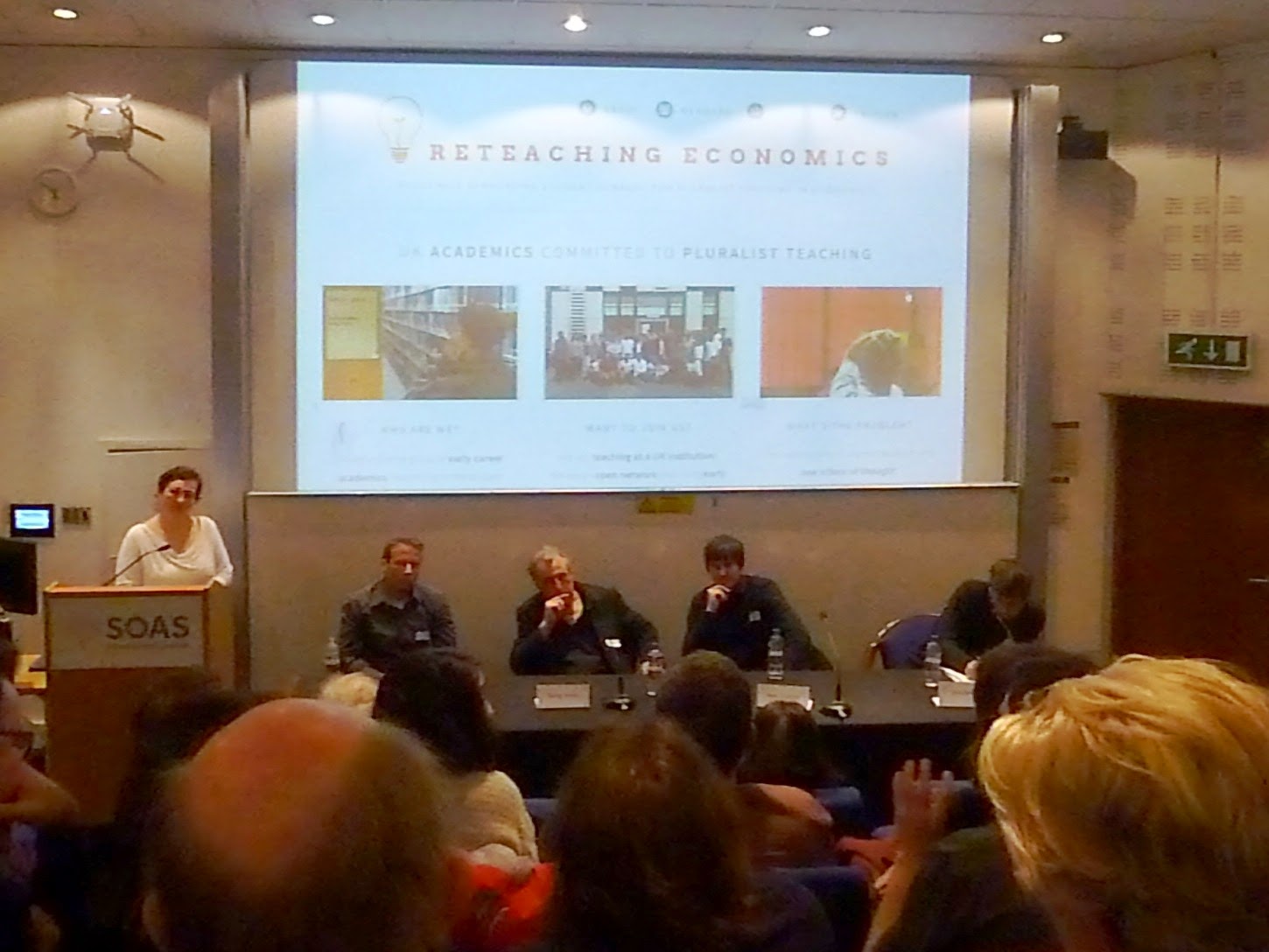
I've seen the new film Boom Bust Boom at two private views: with an audience at De Montfort University and again at SOAS: there was a third private view as part of the excellent INET 2015 Conference "Liberté, égalité, fragilité" (blog post to follow).  The film is great fun... an overview of a Minskian alternative to neoclassical economics, the debate about reforming economics education, and a reminder that private credit is behind almost every bubble. However, at both private views the audience highlighted the film's superficial analysis of power. Ben Timlett, one of the co-directors, liked the suggestion from the SOAS audience to include a puppet of Marx.

The issues of power and gender are endemic to economics. When we were collecting signatures for the ISIPE open letter, we had a real problem finding senior economists to represent our campaign. The early signatories were 90% male, based mainly in Europe and the US. We were so concerned that we began a campaign within the campaign to make our supporters list more diverse. As Daniel Kahneman said in the film, we might not find it easy to de-bias ourselves as individuals, but organisations should be able to. This lack of diversity exists across academia, with only 11% of UK economics professors being female. Things are a little better at Reteaching Economics, with over 40% female members. To borrow the slogan from another campaign, reforming the economic system 'has to be about more than white men' and the film might have done more to counteract these biases.

With these caveats, the film does a great job of outlining a Minskian alternative to neoclassical macroeconomics; discussing the history of financial crises from tulips to railways to sub-prime mortgages; and giving a very accessible critique of neoclassical models. All done with cartoons and puppets, interspersed with interviews, including a double act between Hyman Minsky (the puppet) and his son, Alan. For this Minskian alternative, things are not as bad as Paul Mason suggested when he wrote that 'the radical, pro-Minsky faction is at a disadvantage because it does not possess a complete alternative model of capitalism'. There are plenty of stock-flow consistent Minsky models with debt, including my own, and this modelling tradition has depth and breadth. However, the problems within economics cannot be solved by new models alone.


The film made some useful policy recommendations, including a reminder by Andy Haldane of the need to separate the dangerous (speculative, Ponzi) activities of banks from their steady (hedge) activities. There could have been more discussion of the nature of crisis today, which Kahneman wryly observed 'hasn't ended yet'. The role of offshore finance could also be explored more deeply. Like Kindleberger's 'Manias, Panics and Crashes', the film identifies the role of private credit in forming bubbles, but might have dug into Eurodollar markets, financialisation and offshore credit markets. Creditor-friendly regulators bailed out these powerful, private interests, sowing the seeds of present crises.

Would I recommend this film?  Yes. The cartoons and puppets are great fun; it makes a useful contribution to the debate about alternatives to neoclassical economics; and it is a reminder that private credit is behind almost every bubble. The film is very accessible, to a non-technical audience, which has to be a good thing. Perhaps the solution is to follow up with a second film that analyses the power and politics behind private credit: central banking, offshore finance, gender, tax avoidance, inequality, austerity and so on. Minsky is ignored, not because everyone is swept up blindly by euphoria, but because it is in the interests of those in power to keep the bubble going.

Saturday, 31 January 2015

It's out! The revised UK economics curriculum


Update 4/12/2015 
There was a final review meeting on 1st June 2015, after this Blog post was written. My summary of these discussions is available here. Some changes were accepted  in the final version of the SBSE, available here, in particular:
The phrases 'due to observational equivalence' and 'methodology of science' were dropped
Different methodological approaches are 'understood' rather than the weaker 'appreciated'
'Psychological biases' are included
'A range of evidence' is critically assessed, and methods are 'critically understood'
Despite intense lobbying, 'ethics' was not accepted as an acceptable context alongside 'historical, political, institutional, international social and environmental'. Instead, ethics is a subject area that is 'linked to'.
   ---------

It's out! The UK's subject benchmark statement for economics (SBSE), against which the quality of UK economics degrees is judged, has been published online. The QAA can withdraw degree awarding powers and the right to be called a university if it is not satisfied with standards and quality. This draft 2015 SBSE appears nine months after Rethinking Economics represented student voices at the QAA committee. The QAA have a survey to gather comments from 'anyone with an interest in higher education in the UK' including students, academic staff and graduate employers.

This brief post is to review changes since the 2007 SBSE, by mapping them against student calls for theoretical, methodological and interdisciplinary pluralism.

Theoretical pluralism

There is a new statement that ‘various interpretations of commonly observed economic phenomena exist, due to observational equivalence, and hence explanations may be contested. It is therefore important that economic phenomena are studied in their relevant historical, political, institutional and international contexts' (Section 2.2). Resources are no longer 'scarce' (Section 2.1) and economics is more modestly described as 'a social science' rather than 'a key discipline in the social sciences’ (Section 2.3). The phrase ‘a coherent core of economic principles’ has been replaced with the more open-minded 'relevant principles' (Section 4.1) and the threshold levels required by students refer to 'economic theories and interpretations' rather than just a single 'theory'. Finance and income distribution have been reclassified as dynamic analyses (Section 2.2.) and the subject specific skills include 'market failure' and 'conflicts of interest' (Section 5), perhaps in recognition of Minsky and Marx.

Methodological and interdisciplinary pluralism

The problems with abstraction have been highlighted, with students expected ‘(to appreciate) the specific assumptions that guide the criteria for simplification’ (Section 3.1). Students will be assessed on their ability to use 'evidence and knowledge of institutional and historical context' (Sections 6 and 7). In terms of their role in the broader academy, economists are said to engage with a wider range of disciplines, including ‘finance, international relations, law, ethics and philosophy’.

What is left out?

There are notable absences, and this list is not exhaustive. Although governments were accepted as economic entities, financial institutions were not; and legal and ethical contexts are not included (Section 2.2). The relationship with mathematics and management remains muddled: mathematics is used and management is informed (Section 2.3). Evidence is evaluated and assessed, but never critically. The role of government and the System of National Accounts were rejected as topics, as was re-wording to encompass qualitative and mixed methods. Students are asked to 'appreciate history (of economic thought)' but not to understand it; and there is no requirement to appreciate or understand ethical issues.

For

Monday, 14 July 2014

UK economics curriculum: an open reply to the QAA


To: The Quality Assurance Agency for Higher Education
Southgate House
Southgate Street
Gloucester
GL1 1UB 

15th July 2014 (revised 31 July)


Thank you for the opportunity to suggest further changes to the QAA subject benchmark statement in economics (SBSE). I think the draft needs significant further work for four reasons: repetition; insufficient critical and open thinking; insufficient pluralism; and a need to re-prioritise to reflect employer surveys.

The SBSE could merge sections 4. 'subject knowledge and understanding' and 5. 'subject specific skills and other skills'. Finance and accounting (QAA, 2007) have a single section 3. 'subject specific knowledge and skills'.

There is wording in the both finance and accounting that emphasises critical and open thinking: 'a capacity for the critical evaluation of arguments and evidence'; 'the ability to analyse... unstructured problems' as well as an emphasis on presentation, communication and information technology skills. The SBSE could use similar wording.


The main thrust of the document is 'to abstract and simplify' (2.5) and 'the study of factors that influence income, wealth and well-being'. It could instead emphasise 'the empirical grounding of the subject; being question motivated not tool motivated; and address issues such as growth, distribution and the environment' (personal notes from QAA meeting). The need to discuss the purpose of economics was made in the original INET curriculum proposal (Skidelsky, 2011). For example, topics that come up with student groups include climate change, inequality, unemployment, banking, power, gender, profit retention and tax avoidance.

A lack of theoretical pluralism is apparent in section 4.1 'a coherent core of economic principles' and 5.4 'key concepts'. The SBSE could use similar wording to the finance statement section 2: 'study pursued from a variety of perspectives, including but not restricted to, the behavioural, ethical, economic, sustainable and statistical/mathematical'.

Please note my surprise that finance and employment are considered to be 'static analyses'.


In my view, sections 2.5, 4.3, 5.4, 5.6 and 7 confuse the priorities given in the employer surveys:

The Economics Network Survey of 2012 places 'communication of economic ideas' and 'analysis of economic, business and social issues' ahead of 'abstraction' and lists 'social costs and benefits' as the most important subject-specific knowledge.

The SBE Survey of 2013 prioritised data manipulation, money and banking, financial economics, economic history, cost-benefit analysis, competition, behavioural economics, history of economic thought and financial history. These were ahead of advanced mathematics and mathematical packages. These priorities are either missing, or inconsistent, in these overlapping sections.


Where the committee have proposed changes I support these: the new bullet on 'historic and policy contexts in which specific economic analysis is applied'; engagement with finance, ethics, philosophy and international relations; a new bullet to communicate with 'non-specialists/non-economists'; brief mention of case studies; removal of the word 'scarcity' and inclusion of the words 'phenomena', sectors' and the 'pluralist perspectives/interdisciplinary synthesis' mentioned earlier.

Can you note my disappointment that it took so long to circulate the draft after the 18th March committee: as a result, even these minor revisions will not be available for the 2014-15 academic year.

Thank you for agreeing to widen the consultation to 'gather a full range of perspectives'. I hope that this will include academic groups (WINIR, PKSG, AHE and so on) as well as student groups (PCES, Rethinking Economics, CSEP, GURWES and so on) and other employers (in finance, consultancy and non-profit).

With best regards,
Neil Lancastle

Summary of comments from other committee members
1.  The statement needs rewriting to show how economics has changed since the crisis, to encourage a more pluralist approach to teaching, and to encourage critical inquiry by students.
2.  The statement needs to include economic and financial history, behavioural economics, real world case studies, banking, and the skills and topics prioritised by employers.


References
Economics Network. (2012). Economics Graduates’ Skills and Employability.
http://www.agcas.org.uk/agcas_resources/510-Economics-Graduates-Skills-and-Employability-Final-study-report
SBE Survey. (2013). Teaching Economics after the Crisis: The Results of the Society of Business Economists’ Members’ Survey of January 2013. Available from Society of Business Economists.
QAA. (2007). Finance. http://www.qaa.ac.uk/en/Publications/Documents/Subject-benchmark-statement-Finance.pdf
QAA (2007). Accountinghttp://www.qaa.ac.uk/en/Publications/Documents/Subject-benchmark-statement-Accounting.pdf
Skidelsky, R. et al. (2011). Three year economics undergraduate curriculumhttp://ineteconomics.org/sites/inet.civicactions.net/files/INET_undergrad_economics_curriculum_UK.pdf


Wednesday, 11 June 2014

There are alternatives


More on the lack of public support from CORE for the student letter, calling for 'more open, diverse and pluralist economics'. However,the student letter has been signed by a diverse group of academics and economists (see below). 
This was sent to the FT on 3rd June but not published, hence the Blog.


Sir,


Dr Alvin Birdi’s hope that the CORE curriculum will ‘prioritise empirically important questions’ is welcome. However, he is wrong to dismiss criticism from those outside the project as ‘off the mark and unhelpful’.  Dr Hugh Goodacre’s is not the only dissenting voice; Kate Raworth thinks that ‘to be honest I don’t feel it [CORE] bodes well’ and Ha-Joon Chang and Jonathan Aldred write that ‘teaching undergraduates economics as a series of interconnected debates at best risks needlessly confusing students and at worst actively misleading them...this is unfortunately the view taken by a leading group of curriculum reformers among mainstream economists – the CORE project group’.


There are occasions when CORE members engage with those on the outside calling for alternatives. Andy Haldane wrote a supportive foreword to the report by students at Post-Crash Manchester, but they were dismissed by Diane Coyle as failing to ‘recognise the breadth of the courses available’ and by Simon Wren-Lewis as being 'fundamentally misguided’.

More generally, the CORE steering group and CORE contributors appear united in their dismissal of alternative curricula: not a single one appears to have signed the ISIPE open letter. Surely someone from CORE has an encouraging word for the students? After all, the letter is signed by a diverse group of academics and economists, many of whom leave helpful comments: Ann Pettifor, Stephanie Blankenberg, Molly Scott Cato, Robert Pollin, Michael Ash, Achim Truger, Arne Heise, Doyne Farmer, Thomas Piketty, Lord Robert Skidelsky, Alan Kirman, Ha-Joon Chang, James Galbraith, Peter Mooslechner, Lars P. Syll, Victoria Chick, Geoffrey Harcourt, Marc Lavoie, Geoffrey M. Hodgson, Sheila Dow, John Komlos, Paul Davidson, Steve Keen, Engelbert Stockhammer, Jean-Paul Fitoussi, Matheus Grasselli, Gary Dymski, John Weeks, Ken Binmore, Malcolm Sawyer, Mathew Forstater, Ozlem Onaran, Stephen Fazzari, Sheri Markose, Tae-Hee Jo, Thomas Palley and Yuval Millo. 

Best regards,
Neil Lancastle

Postgraduate student in finance and economics, University of Leicester